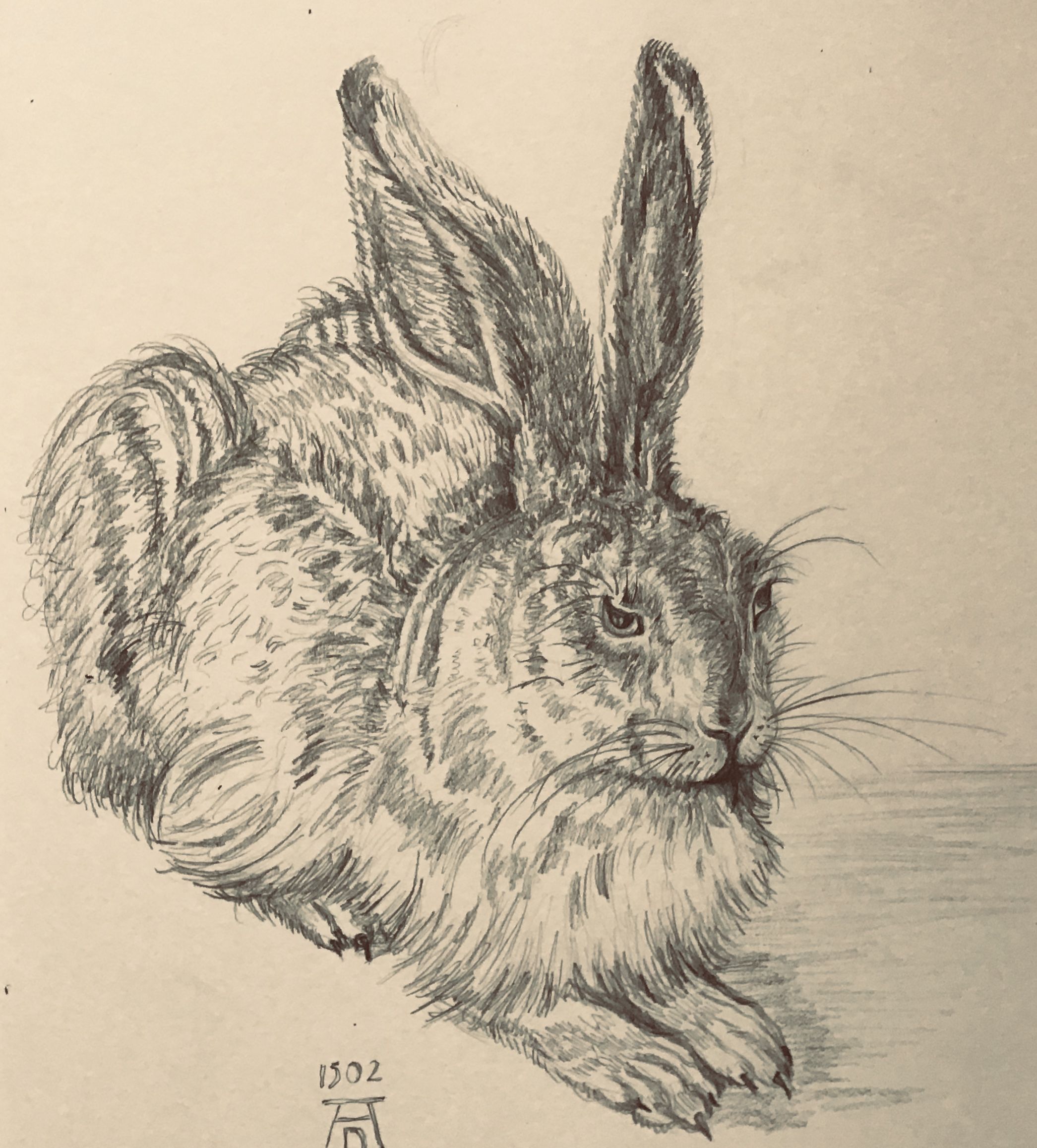
after Albrecht Dürer, Young Hare (1502). Graphite on paper.
The first six weeks of Practice classes are a sequence of exercises. They follow the premise of this course, that all drawing starts with copying, and they move deliberately from the simple to the complex and from the observed to the imagined: geometric forms drawn from life, then from memory; more complex objects; plaster casts in the studio; reflective surfaces; and finally imaginative space. Each exercise introduces a drawing concept, a tool and a surface, so that by the end of the six weeks you will have drawn with the full range of tools on the full range of grounds, and will know what each does well and badly. These are the options you will draw on when you make your projects. Keep everything, including failures. Your exercise drawings are creative research and will be reviewed with your sketchbook.
Exercise 1/6 – Line I: Contour & Gesture Subject: geometric solids (cube, sphere, cylinder, cone) set up in the studio. We begin where drawing instruction has always begun, with the basic geometric shapes, drawn as seen. The set-up is then changed and redrawn, and finally drawn from memory with the objects removed. Concepts and vocabulary: contour, blind contour, gesture, weighted line, structural/construction line, the ellipse, sighting and measuring, proportion. Tool: graphite (a range of grades, from hard to soft, and graphite sticks). Surfaces: newsprint and medium-weight white drawing paper.
Exercise 2/6 – Line II: Cross-Contour, Structure & Space Subject: more complex everyday objects (shoes, tools, folded cloth, bicycle parts), observed, then redrawn from memory. Concepts and vocabulary: cross-contour, overlap, foreshortening, line variation, lost-and-found line, implied line. Tools: ballpoint pen (biro) and colored pencil (building color through layering). Surfaces: papers of different weight and texture, from smooth Bristol to toothy cold-press, so that the same line can be compared across grounds.
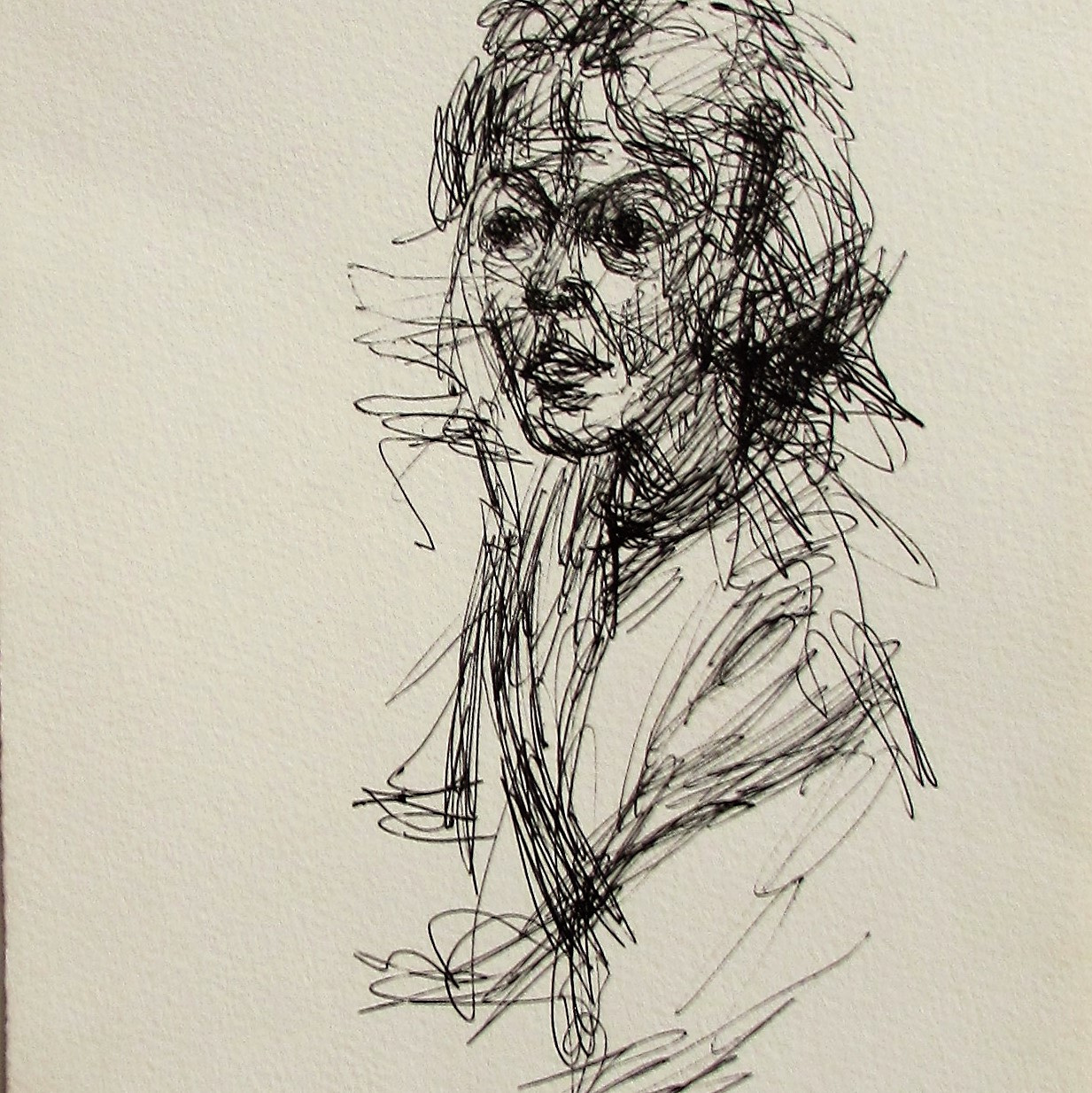
Alberto Giacometti Tête de femme (portrait d’Annette) Ballpoint pen on paper.
Exercise 3/6 – Tone I: Value, Light & Form Subject: the geometric solids again, then a more complex object, under a single light source. Concepts and vocabulary: value scale, hatching, cross-hatching, stippling, blending, light, halftone, core shadow, reflected light, cast shadow, chiaroscuro. Tools: conté crayon (black, sanguine and white) and graphite. Surfaces: toned papers (grey and buff) for a three-value drawing, and black paper for drawing with light.
Exercise 4/6 – Tone II: The Plaster Cast Subject: plaster casts in the studio (hands, feet, classical heads), a longer study in the tradition of the academy. Concepts and vocabulary: tonal massing, hard and soft edges, sfumato, tenebrism, atmosphere and depth. Tool: water-soluble graphite, used dry and with brush and water. Surfaces: heavyweight watercolor papers (hot-press and cold-press) that can take water.
Exercise 5/6 – Reflective Surfaces & High Contrast Subject: reflective objects (metal kettles, spoons, glass, foil, mirrors). Reflections distort and invert, and force us to draw what we see rather than what we know. Concepts and vocabulary: notan, negative drawing, positive and negative space, high contrast, mark-making. Tool: pen and brush with ink (dip pen, brush, dry brush, wash), with white ink or gel pen on black. Surfaces: black paper and Bristol, plus a first introduction to alternative surfaces: primed wood panel and canvas.
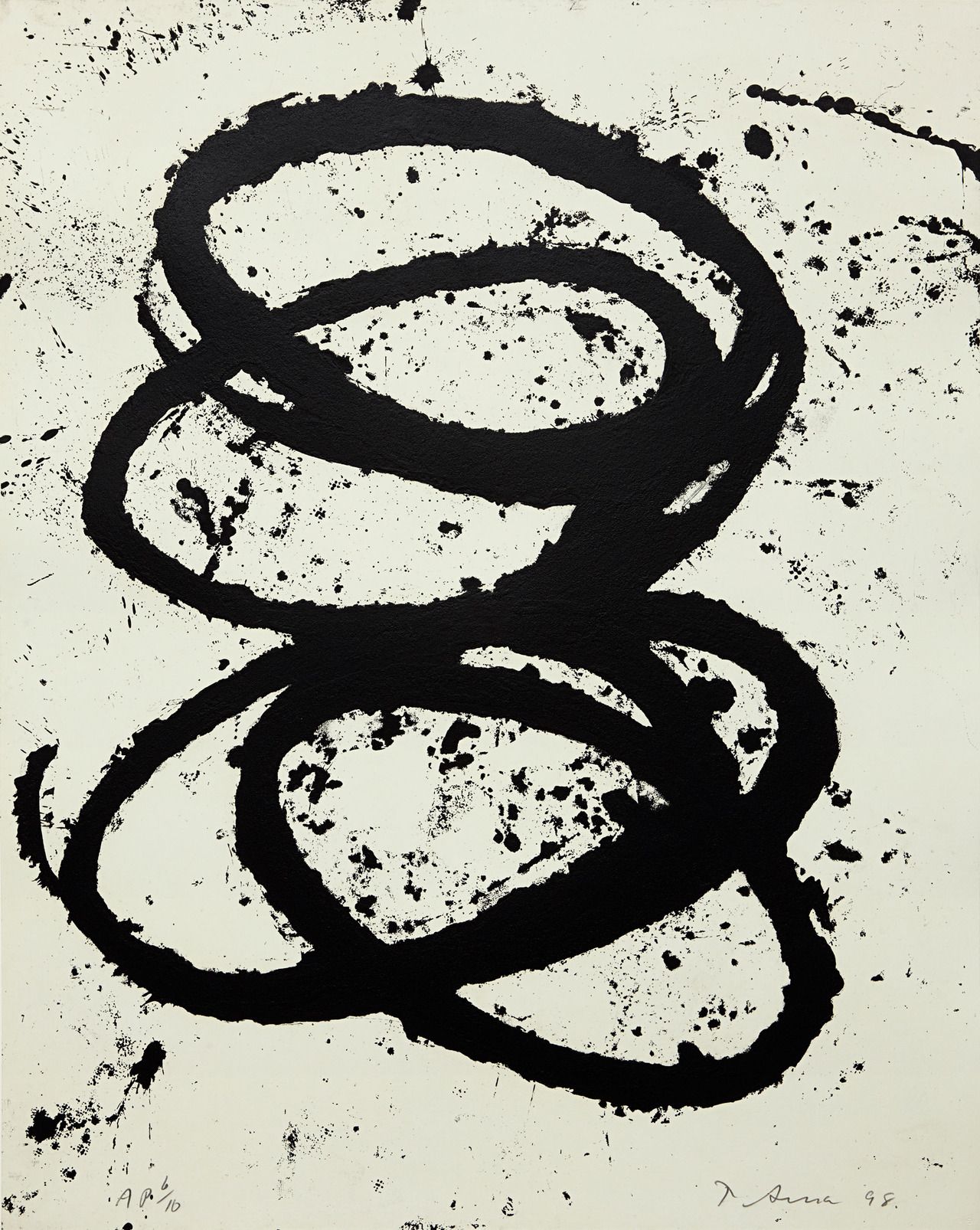
Richard Serra, Untitled, 1998. Black ink print, artist’s proof 6/10.
Exercise 6/6 – Imagined Space: Construction & Dream This is the most substantial exercise and is designed to prepare you directly for the projects. It moves from observation into imagination in two parts. Part A, Constructivist and Cubist: take apart your own observed studies and rebuild them using multiple viewpoints, planes, geometry and collage. Part B, Surrealist: use automatism, frottage, the exquisite corpse, dream imagery and hybrid forms to generate drawings you could not have observed. Tools: your choice, using at least three tools from the course. Surface: your decision. Wood panel, canvas and fabric are all valid, and so are found materials (a bed sheet, for example). You will be asked to explain your choices.
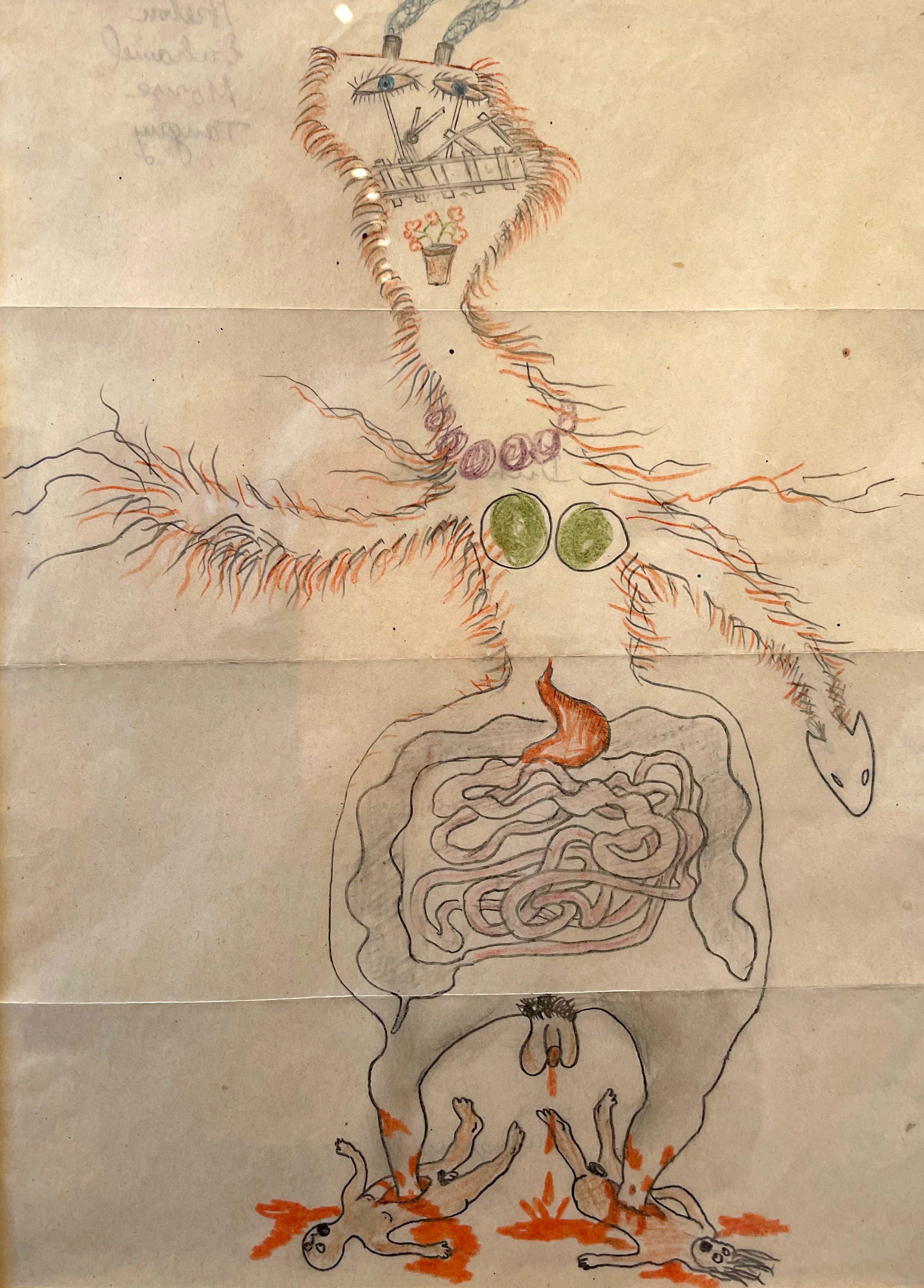
Yves Tanguy, Joan Miró, Max Morise and Man Ray, Cadavre exquis (Nude), 1926–27. Ink, pencil and colored pencil on paper.
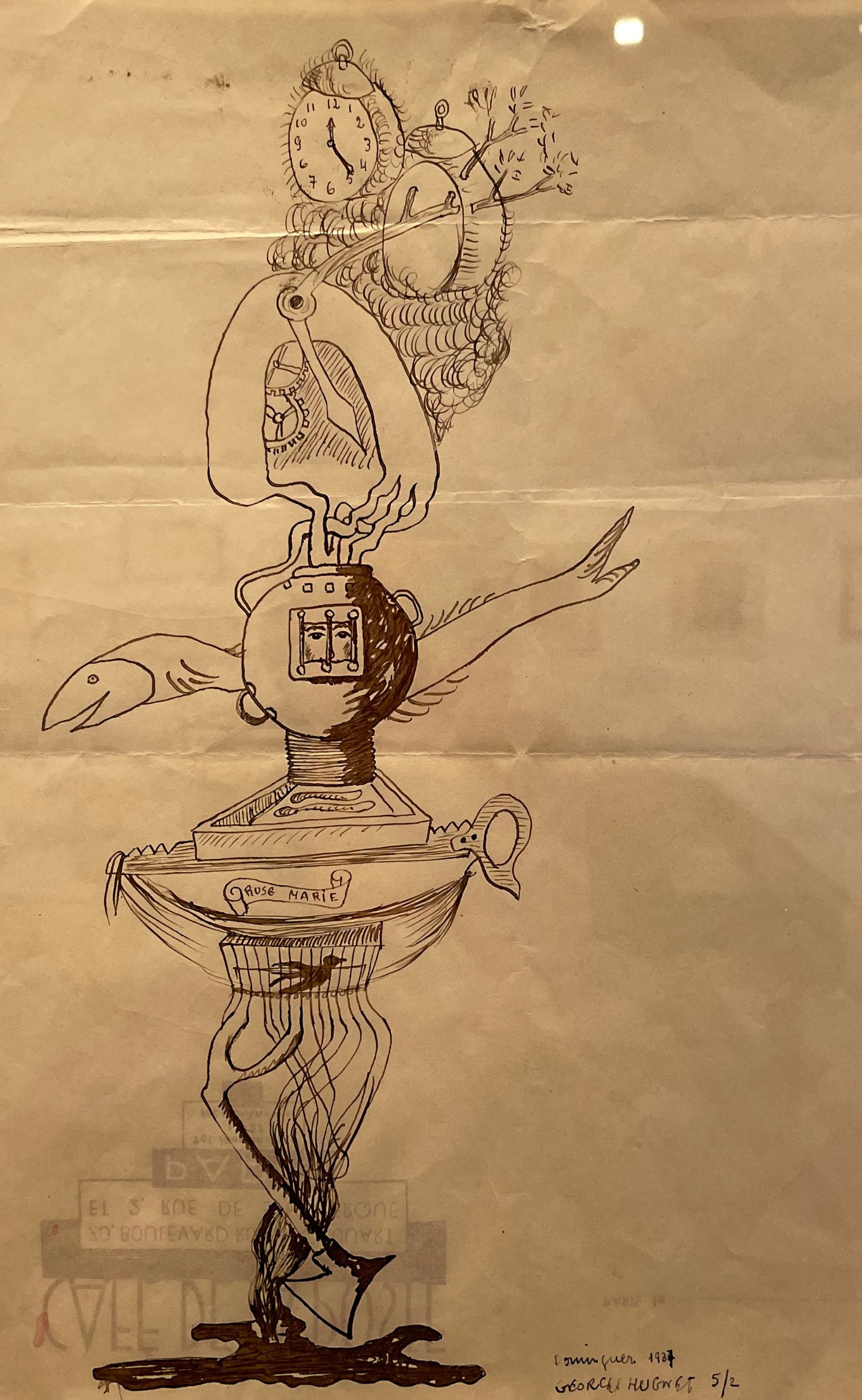
Óscar Domínguez and Georges Hugnet, Cadavre exquis, 1937. Ink on paper.